RA-L 2026
RADAR · IMU · LiDAR

TRaIL-Odom
Tightly Coupled Continuous Time Radar-IMU-LiDAR Odometry with Adaptive Doppler Weighting

Chiyun Noh1, Turcan Tuna2, William Talbot2, Marco Hutter2, Laurent Kneip3*, Ayoung Kim1*

1Seoul National University  ·  2ETH Zürich  ·  3Robotics and AI Institute

*Corresponding authors

Abstract

Existing radar-LiDAR fusion methods rely on fixed residual weights, even though the informativeness of radar Doppler and LiDAR geometry is scan- and direction-dependent, leading to uniform radar weighting that misallocates Doppler information across translational directions.

To address this limitation, we propose two degeneracy-aware Doppler reweighting modules within a tightly coupled Radar-IMU-LiDAR odometry framework: per-point radar reweighting and scan-wise radar gain scheduling. Since geometric degeneracy is directional, we first identify weak translational directions from the LiDAR geometry and reweight individual radar Doppler constraints based on their alignment with the weak subspace. We further adjust the overall radar contribution using LiDAR geometric anisotropy such that radar is emphasized when LiDAR observability is poor and suppressed when LiDAR constraints are already reliable. Across 13 evaluated sequences, TRaIL-Odom achieves state-of-the-art overall performance, with clear advantages in geometrically degenerate scenes. In ablation experiments on three degenerate sequences, combining the two adaptive weighting modules reduces RMSE ATE and RTE by 86.0% and 78.5% relative to the fixed-weight baseline.
Method

1

Robust Radar-IMU-LiDAR Odometry Across Diverse Environments

Fuses asynchronous radar Doppler, IMU, and LiDAR measurements in a continuous-time B-spline optimization framework for robust odometry across diverse real-world environments.

2

Degeneracy-Aware Per-Point Reweighting

Identifies weak translational directions from LiDAR geometry and reallocates individual radar Doppler constraints toward the weak subspace while limiting influence along well-constrained directions.

3

Scan-Wise Radar Gain Scheduling

Adjusts the overall Doppler contribution using LiDAR point-cloud anisotropy, emphasizing radar under severe degeneracy and suppressing unnecessary influence in well-constrained scans.

Public Dataset

We release a real-world multi-sensor dataset designed to evaluate odometry under geometrically degenerate conditions.

01

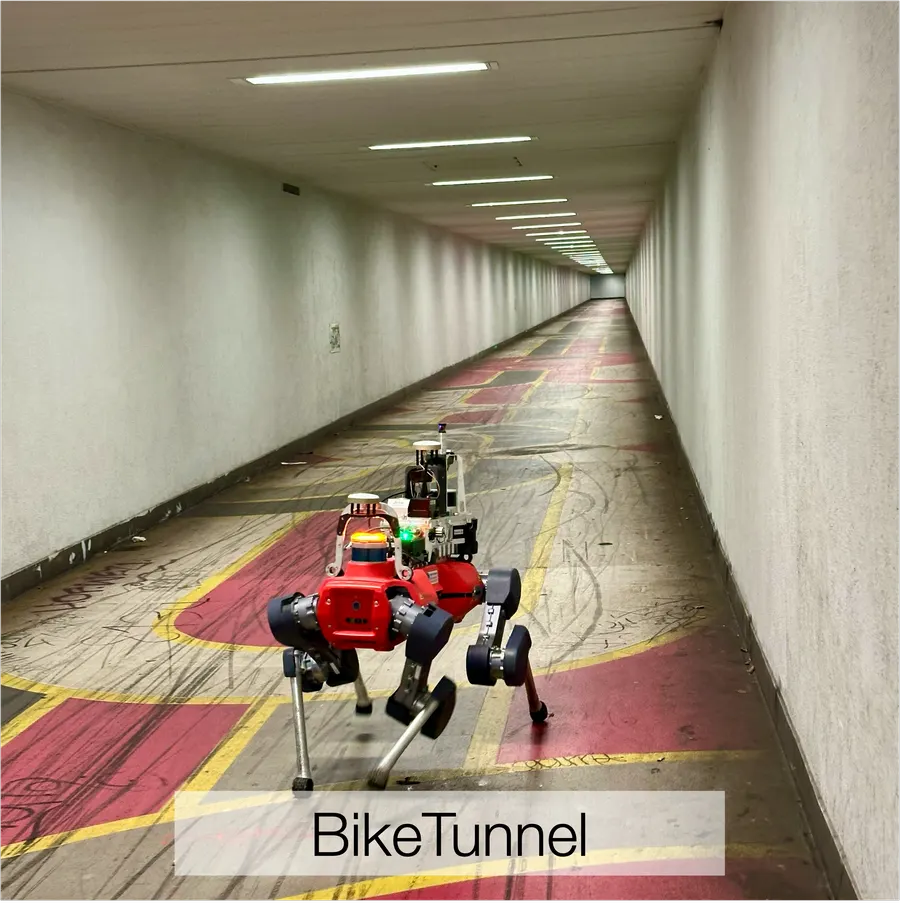
BikeTunnel

Long, repetitive tunnel geometry with limited translational constraints.

BikeTunnel1
360.34 m
BikeTunnel2
153.84 m
02

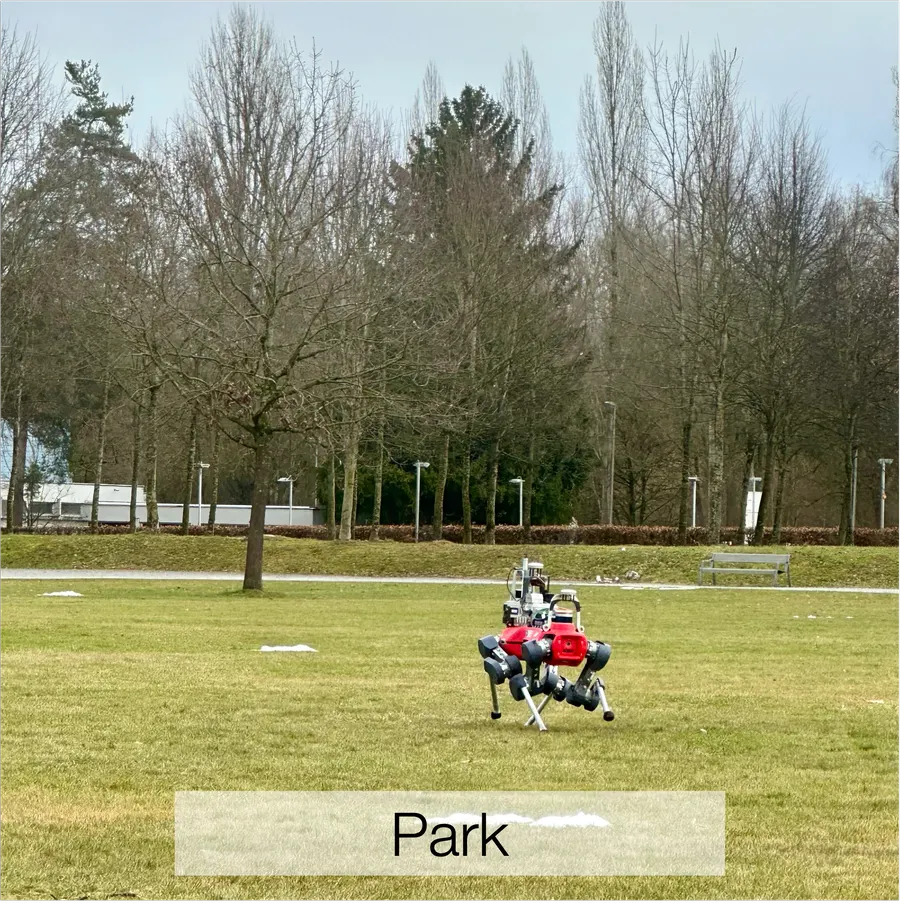
Park

Open park scenes with sparse structures and weak geometric observability.

Park1
159.60 m
Park2
265.17 m
03

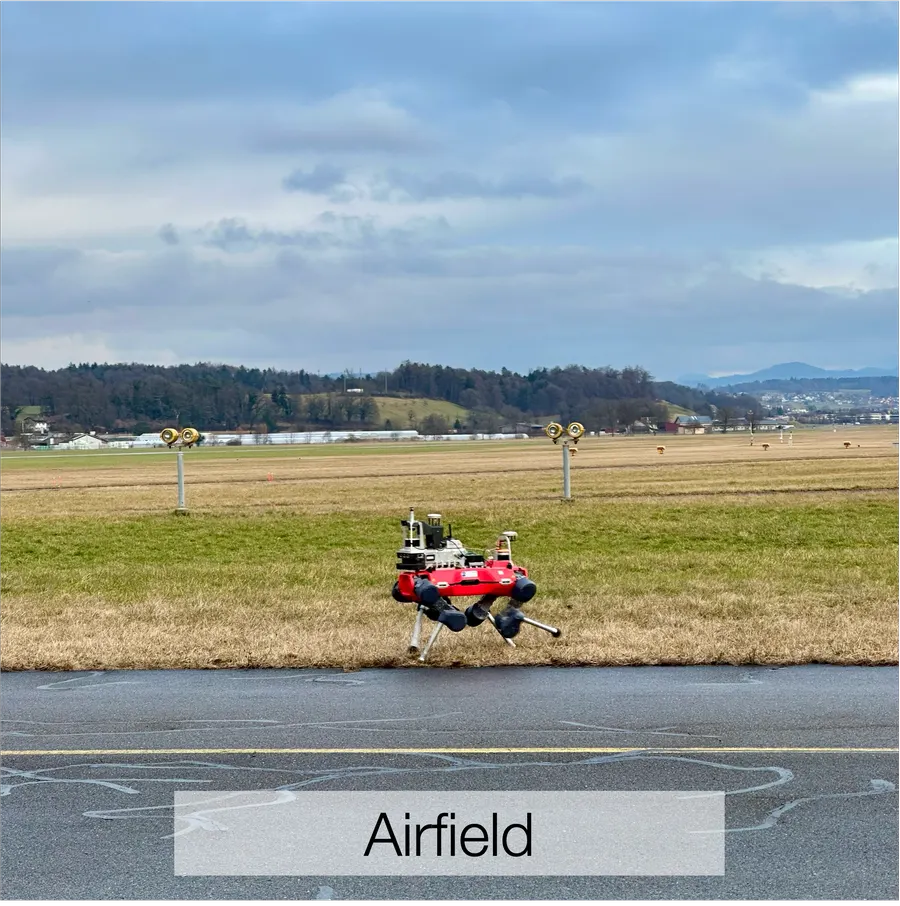
Airfield

Open-field trajectories with sparse and distant geometric features.

Airfield1
198.98 m
Airfield2
208.65 m

Results

ATE [m] / RTE [m/m]. Lower is better; × indicates failure.

MethodBikeTunnel1BikeTunnel2Park1Park2Airfield1Airfield2
GenZ-ICP××××××
FAST-LIO2×66.072 / 1.8292.296 / 0.23411.354 / 0.2990.681 / 0.2161.894 / 0.194
SuperOdom××××××
DLIO××1.008 / 0.1621.219 / 0.1590.627 / 0.1410.942 / 0.139
RESPLE××××0.611 / 0.1150.464 / 0.110
DR-LRIO1.881 / 0.0690.605 / 0.0970.853 / 0.0731.820 / 0.0611.399 / 0.0622.485 / 0.067
GaRLIO2.507 / 0.0971.558 / 0.2500.423 / 0.0354.602 / 0.0390.773 / 0.0280.580 / 0.025
Ours-LIO×12.352 / 0.546××9.627 / 0.1800.127 / 0.027
Ours-RLIO1.532 / 0.0500.485 / 0.0471.010 / 0.0331.524 / 0.0470.183 / 0.0260.142 / 0.024

Citation

@article{noh2026trailodom,
  title={TRaIL-Odom: Tightly Coupled Continuous Time Radar-IMU-LiDAR Odometry with Adaptive Doppler Weighting},
  author={Noh, Chiyun and Tuna, Turcan and Talbot, William and Hutter, Marco and Kneip, Laurent and Kim, Ayoung},
  journal={IEEE Robotics and Automation Letters},
  year={2026},
  url={https://chiyunnoh.github.io/TRaIL-Odom/}
}